
Please note that all research opportunities listed below may not be open at any particular time, but if you are interested, please contact the faculty member directly
Ketterson Group
The Ketterson group is currently pursuing magnetic resonance studies in nano-structured materials including thin films and various “mesoscopic” materials patterned by optical and (for submicron objects) electron beam lithography. The resonances we study occur when the spins that are present in all ferromagnetic materials are driven at their  natural precession frequency (basically the Larmor frequency) by an applied microwave field (the experimental set-up used is shown above). More generally this precession phenomena can advance as a wave through the host material, a so-called spin wave, and our group has developed techniques to generate and detect such waves having wavelengths extending from millimeters to microns and smaller.
Undergraduates who are curious about, or might want to participate in, such experiments are invited to stop by or contact us; possible projects include: magnetic film deposition, patterning submicron things, microwave measurements, and computer code development (for data acquisition and analysis).
For further information, contact John Ketterson
Data Analysis At The High Energy Frontier
The Large Hadron Collider (LHC) at CERN (Geneva, Switzerland) continues to deliver extensive data sets describing all sorts of high-energy proton-proton collisions. The CMS experiment is one of two general-purpose detectors that record enormous amounts of collision data. CMS physicists analyze these data and measure the rates of key processes in order to test our understanding of proton structure, gauge boson properties, and higher-order quantum chromodynamics. Members of the faculty at Northwestern play a highly visible role in the collaboration and are involved in several of the most important measurements. The LHC measurements have not yet been critically examined and organized, and we seek the assistance of a student with an interest in particle physics and some rudimentary knowledge of computer programming.
For further information, contact Professor Michael Schmitt
Stern Lab
The Stern Lab explores quantum materials using the interaction of light with matter. We focus specifically on low-dimensional nanomaterials. Single layers of materials thinner than a nanometer exhibit unique optical and electronic properties that are useful for a wide range of devices. The interaction between light and these materials can be controlled by integrating them into microcavities designed to shrink the size of a single part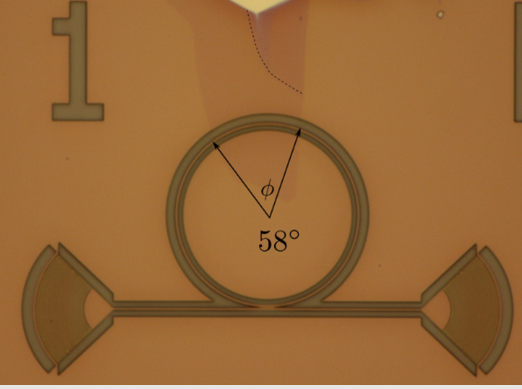 icle of light, or a photon. At the same time, the characteristics of these nanomaterials can be tailored by stacking several atomically-thin layers on top of each other. We are developing methods to combine these “layered heterostructures” with optical microcavities to explore exotic light-matter quasiparticles with uniquely tunable properties. Our current work focuses on developing methods to create hybrid optoelectronics devices, as shown in the figure, which requires overcoming the challenges of layered device and material assembly. In upcoming projects, we also plan to use these layered heterostructures to investigate emergent phenomena like edge transport and dynamics of superconductivity.
For further information, contact Professor Nate Stern
Driscoll Lab
The Driscoll lab is an experimental soft matter physics lab – we focus on studying fluids and soft and squishy solids. Our main tools are high-speed photography and various kinds of light microscopy. We study how patterns & structures form when you try and pull these soft systems apart; an everyday example of this is the drips that form on a newly pain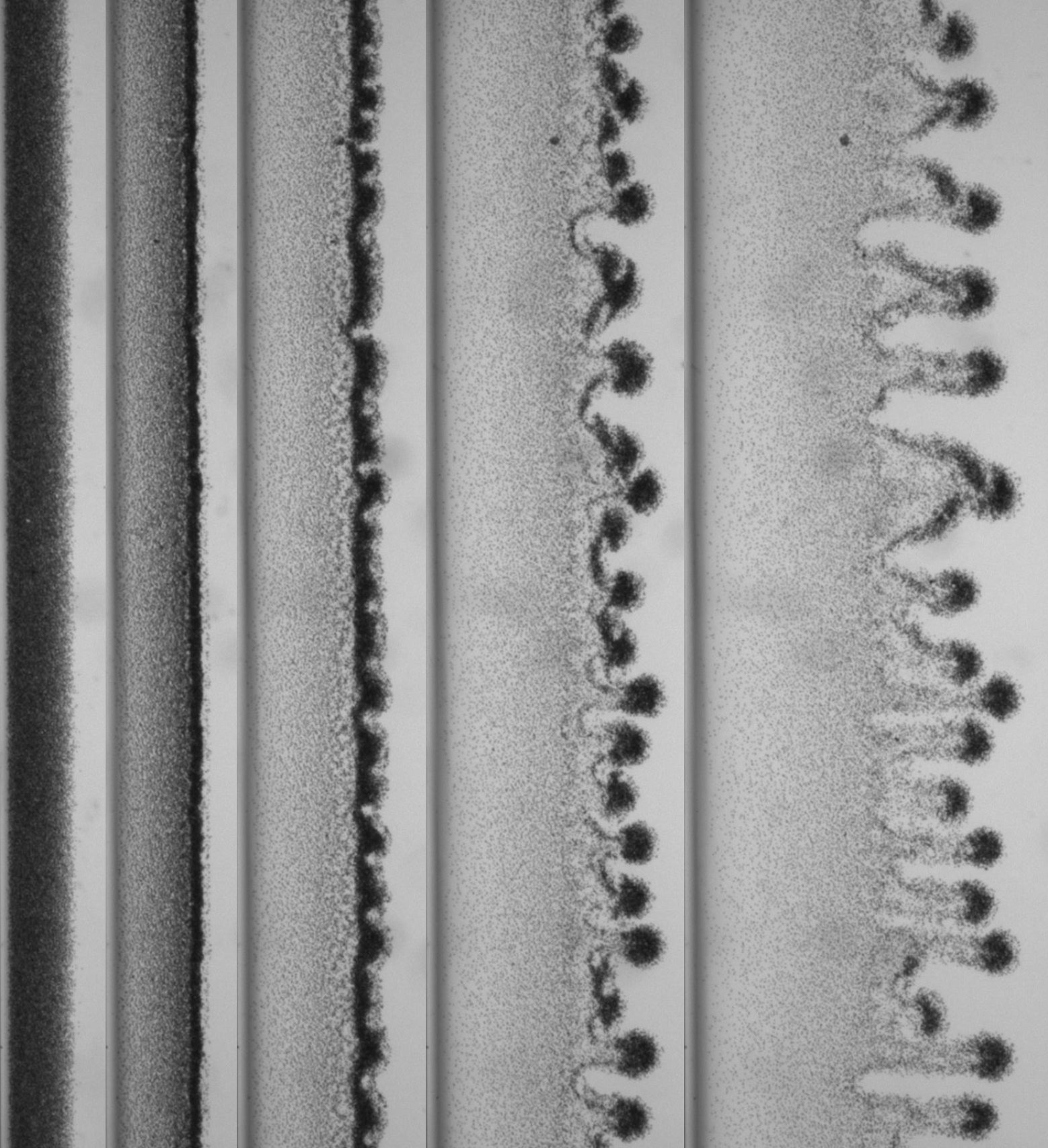 ted wall. The spacing between these drips encodes information about the strength of the pulling (gravity) vs. how strongly the paint is resisting it (viscosity & surface tension). The Driscoll lab’s theme is to look carefully at how things break apart to try understand what was holding them together. By developing a deeper understanding of the patterns and structures which emerge as a material fails, we can learn not only how to control these structures, but also how to use them to learn something new about the material.
For more information, contact Professor Michelle Driscoll
Geraci Lab
The Geraci group has research interests that include tabletop tests of fundamental physics, including tests of the gravitational inverse square law at the micron length scale using levitated microspheres, laser-trapping and cooling of nanoparticles for ultra-sensitive force detection, quantum opto-mechanics with cold atoms coupled to mechanical resonators, and NMR-based laboratory searches for the QCD axion, a notable Dark Matter candidate.
Opportunities exist for undergraduate students to participate in The Axion Resonant Interaction Detection Experiment (ARIADNE). Axions are particles predicted to exist to explain the apparent smallness of the neutron electri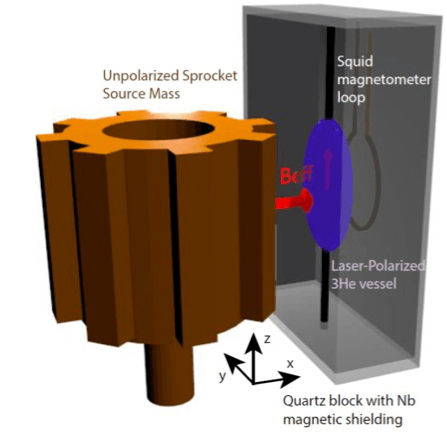 c dipole moment. While also being promising candidates for dark matter, in tabletop experiments axions can mediate short-range spin-dependent forces between objects. As part of an international collaboration, we are developing a new experiment for detecting short-range forces from axion-like particles based on nuclear magnetic resonance in hyperpolarized Helium-3. The method can potentially improve previous experimental bounds by several orders of magnitude and can probe deep into the theoretically interesting regime for the QCD axion, over a range that is complementary to existing axion search experiments.
Undergraduates who are potentially interested in working on this experiment or others are invited to stop by or contact us; possible projects include: superconducting film deposition, finite-element modeling, laser interferometry, feedback-control software development, and data analysis.
For more information, contact Professor Andrew Geraci
Kovachy Group
The Kovachy Group uses the quantum mechanical, wavelike nature of atoms cooled to a billionth of a degree above absolute zero to measure forces extremely precisely. These atomic sensors can measure forces 100 billion times smaller than the force exerted by Earth’s gravity on a single atom. We utilize this exceptional sensitivity to search for new fundamental particles, including those potentially relating to dark matter or to the extra dimensions that can arise in string theory. As a member of the Mid-band Atomic Gravitational Wave Interferometric Sensor (MAGIS) collaboration, the group is working towards the construction of an atomic gravitational wave detector that would be complementary to LIGO. The figure shows actual data of interference fringes arising from the wavelike behavior of individual atoms. These fringes encode information about the gravitational field of an 84 kg mass placed near the atoms.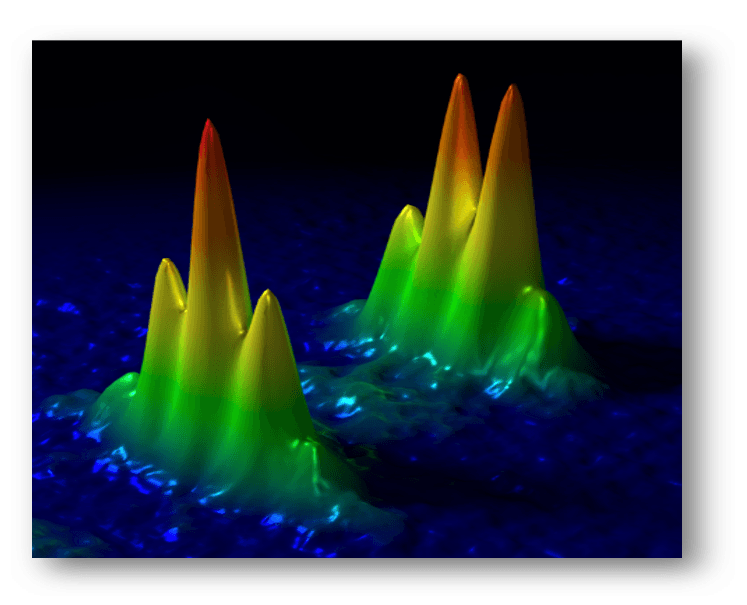
Undergraduates who think that they may be interested in the Kovachy Group’s research can contact Tim Kovachy at timothy.kovachy@northwestern.edu, or stop by his office (Tech Building F133). Possible projects include: analysis of noise backgrounds for an atomic gravitational wave detector and associated mitigation strategies, simulations of new techniques to improve the sensitivity of atomic force detectors, and building laser systems for cooling and manipulating atoms.