Faculty

Dr. Stephanie Fryberg, Professor
Dr. Stephanie A. Fryberg, a member of the Tulalip Tribes of Washington State, is a Professor of Psychology at Northwestern University. Dr. Fryberg is also the Founding Director of The Research for Indigenous Social Action and Equity. As a social and cultural psychologist, her research focuses on how social representations of race, culture, and social class influence the development of self, psychological well-being, physical health, and educational attainment. In addition to publishing articles in leading academic journals, Dr. Fryberg provided testimony to the U.S. Senate Committee on Indian Affairs, received the Society for the Psychological Study of Social Issues Early Career Award, and was inducted into Stanford University’s Multicultural Alumni Hall of Fame.

Dr. Cong Wang, Research Assistant Professor
Dr. Cong Wang is a Research Assistant Professor in the Department of Psychology. She obtained her Ph.D. in educational psychology from Purdue University in 2019. Dr. Wang’s research focuses on understanding the contextual and individual factors that promote student motivation and learning. She is particularly interested in addressing problems of educational inequality by promoting feelings of belonging, motivation, and performance for students from lower-socioeconomic status and racial minority backgrounds.
Main Collaborators
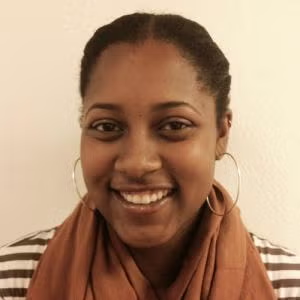
Dr. Arianne Eason, Assistant Professor
Dr. Arianne Eason is an Assistant Professor at UC Berkeley’s Department of Psychology. She is part of the Developmental and Social-Personality area. Her work focuses on Racial Segregation and Same-Race Preferences, Bias towards Native Americans, and Perceptions of Resource Possession and Allocations in Infancy.

Dr. Laura Brady, Senior Researcher
Dr. Laura Brady is a Senior Research at American Institutes for Research (AIR). She received her B.A. in Psychology with minors in Gender and Women’s Studies and Professional Writing from DePaul University in 2011. In 2016, Laura completed her doctoral studies in Psychology at the University of Washington where she earned a Ph.D. in Social and Personality Psychology. Broadly, Laura is interested in understanding issues of race, gender, social class, and education through the lens of culture. She is particularly drawn to research that seeks to solve real world problems of inequality and injustice, and much of her research is driven by a desire to use social psychology to make positive social change.

Research for Indigenous Social Action and Equity (RISE)
We have collaborated closely with a multidisciplinary group of humanists and social scientists committed to addressing and undoing Indigenous inequalities. You can learn more about their work on the RISE website!
Postdoctoral Researcher

Dr. Kate Morman
Dr. Morman recently completed her doctorate from University of Michigan’s Combined Program in Education and Psychology. Her research aims to unpack educational infrastructure capable of sustaining educator practices that meaningfully center students’ cultural backgrounds. She is a third-generation educator who was raised in Kansas City and became an adult in Phoenix. A true millennial, she spends her time outside work hiking, crafting, and reading.
Lab Members

Jamie Yellowtail, Graduate Student
Jamie Yellowtail (she/her) is a 5th year PhD Candidate in Social Psychology at the University of Michigan. She is a Northern Cheyenne (Tsistsis’tas) tribal member raised on the Crow (Apsàalooke) reservation in Montana in the Mighty Few District (Iikooshtaka’atbaatchaache). Her Cheyenne name is E’se’vone meo na’e- Buffalo Road Woman. As a first generation college student, she received her B.A. in International Studies and B.S. in Psychology from the University of Wyoming. She received her M.S. in Psychology from the University of Oregon in 2020, supervised by Dr. Gerard Saucier. Under the supervision of Dr. Stephanie Fryberg (Tulalip), Jamie’s PhD research aims to investigate psychological factors that exacerbate sexual violence towards Native women. Future work will focus on the development of theory based interventions to reduce sexual violence. In her free time, she enjoys working out, anything outdoors, traveling to new places, and spending time with her pup, Little Bill.

Alana Smutz, Graduate Student
A third-year graduate student in the Culture Collaboratory. Alana is originally from Oʻahu, Hawaiʻi, but primarily grew up in the Pacific Northwest where she received her B.S. in Psychology from Western Washington University. Alana is broadly interested in researching
how cultural practices, land, and place influence the development of self, identity, health, and well-being, particularly among Native populations.

Hailey Shangin, Graduate Student
Hailey Shangin is a Ph.D. candidate in the Social Area of the Department of Psychology at the University of Michigan. She was born and raised in Alaska before moving across the country to attend Brown University, where she earned her B.A. with Honors in 2022, double majoring in Behavioral Decision Sciences and Psychology. In graduate school, her research focuses on how perceptions of inequality and bias are formed, maintained, and perpetuated. Her ultimate goal is to understand the role of biases in order to develop more effective interventions and improve accessibility for minoritized groups, including Indigenous peoples.

Hannah Ramil, Graduate Student
Hannah Ramil is a Social Psychology PhD candidate at the University of Michigan. Broadly, she is interested in understanding how individual attitudes and behaviors are shaped by group identities. To this end, she has investigated how perceptions of ingroup support for “canceling” moral violators shape liberal and conservative individuals’ own willingness to engage in “cancel culture.” She has also examined the role of national identity in shaping individuals’ experiences of threat, leading to anti-Native American prejudice. Currently, she is becoming increasingly interested in how assessments of ingroup and outgroup political attitudes lead to political polarization. See her CV here.